# Why Linux Still Wins for SaaS Infrastructure in 2026
**Published:** 2026-09-28
> Linux for SaaS Infrastructure: The Strategic Foundation That Scales <b>TL;DR:</b> Linux powers over 90% of global cloud infrastructure, offering SaaS founders zero licensing costs, superior security, and native compatibility with modern development stacks like…
# Linux for SaaS Infrastructure: The Strategic Foundation That Scales
TL;DR: Linux powers over 90% of global cloud infrastructure, offering SaaS founders zero licensing costs, superior security, and native compatibility with modern development stacks like Laravel and PHP. This open-source foundation eliminates vendor lock-in while providing the production-grade reliability and horizontal scaling capabilities that define successful cloud-native products.
## Key Takeaways
- Linux eliminates server licensing fees entirely, letting startups reinvest thousands directly into product development and growth
- Open-source security architecture enables rapid vulnerability patching (often within 24-48 hours) and granular process isolation for multi-tenant applications
- Native compatibility with Docker and Kubernetes gives early-stage companies access to the same enterprise-grade scaling infrastructure used by Fortune 500s
- The LEMP stack (Linux, Nginx, MySQL/PostgreSQL, PHP) remains the battle-tested standard for Laravel applications requiring production reliability
- Market dominance creates powerful network effects with comprehensive documentation, active communities, and seamless cloud provider integration
## The Infrastructure Decision That Defines Your SaaS Future
Your infrastructure choice in month one determines your scaling ceiling in year three. Founders constantly balance cost, speed to market, and future scalability. Linux serves as the invisible foundation behind successful SaaS companies.
Choosing Linux for SaaS infrastructure goes beyond saving money. It establishes strategic positioning. Open-source infrastructure ensures stability and long-term viability in a highly competitive market.
## Why Does Linux Dominate Cloud Infrastructure?
Linux runs an estimated 90% of public cloud workloads across AWS, Google Cloud, and Azure. This dominance isn't accidental. Hyperscalers chose this operating system for its unmatched efficiency, customization, and permissive licensing.
High market share creates a massive network effect for developers. Native tooling, comprehensive documentation, and active community support make problem-solving incredibly fast.
AWS Linux, Ubuntu LTS on Google Cloud, and Azure Linux provide standardized environments. Startup teams spend less time fixing server issues and more time writing feature code.
Data center racks representing Linux cloud infrastructure## How Does Linux Cut Costs for SaaS Startups?
Proprietary server operating systems drain startup capital rapidly. Windows Server Standard edition costs approximately $1,000+ per license with per-core pricing models. A modest three-server infrastructure instantly generates thousands in baseline licensing debt.
Linux distributions like Ubuntu and Rocky Linux eliminate these fees entirely. Zero licensing costs avoid hidden expenses like Client Access Licenses and forced upgrade cycles.
The system also runs highly efficiently. PHP-FPM memory footprints remain significantly lower on Linux than on alternative platforms. The same hardware runs more workloads, compounding your savings as you scale.
> "The combination of Dradis CE and our Docker/Kubernetes infrastructure gives DeepBlue enterprise-level security assessment capabilities without any licensing overhead. We can spin up isolated environments for each client engagement while maintaining operational standards."
>
> Max Duijsens, CTO at DeepBlue Security & Intelligence
## What Makes Linux More Secure for SaaS Applications?
Security incidents destroy SaaS businesses overnight. According to IBM's 2024 Cost of a Data Breach Report, the average breach cost reached $4.88 million. Open-source transparency creates a massive security advantage.
Thousands of developers inspect the kernel code, making bugs shallow and easy to spot. Linux kernel maintainers typically release patches for critical vulnerabilities within 24 to 48 hours.
The system includes built-in enterprise features like SELinux, AppArmor, namespaces, and cgroups. Granular process isolation protects multi-tenant SaaS architectures effectively. Tools like iptables and systemd directives allow strict access control.
## Why Do Laravel and PHP Thrive on Linux Infrastructure?
The LEMP stack (Linux, Nginx, MySQL or PostgreSQL, and PHP) remains the battle-tested standard for production reliability. Native synergy exists between these technologies.
Developers built PHP-FPM, Composer, and Artisan specifically for Linux environments. Laravel applications see massive performance gains on this infrastructure. Modern features like Laravel Octane optimize perfectly with Linux Unix sockets and systemd integration.
Containerized setups mirror production servers exactly. Your development team deploys code with absolute confidence.
## How Does Linux Enable Modern SaaS Scalability?
Horizontal scaling means adding more servers to handle increased traffic. Containerization uses Docker as the absolute packaging standard. Docker allows you to wrap your application into portable units.
Kubernetes orchestration scales these containers just like Fortune 500 companies do. Linux makes this exact technology accessible to early-stage startups. Modern cloud-native architecture relies on microservices and load balancing.
You can easily start with a monolith and transition to containers later. You can eventually introduce orchestration as your user base grows.
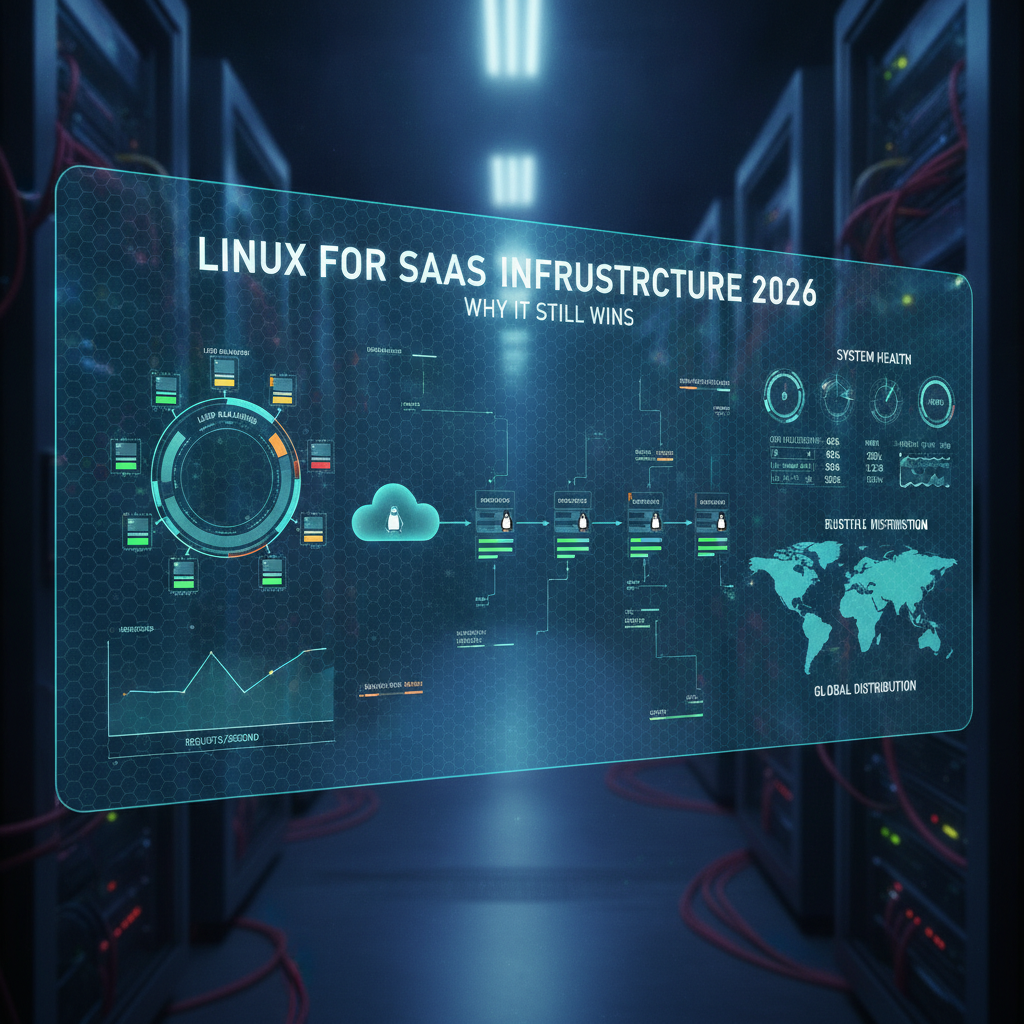Analytics dashboard displaying container orchestration and scaling metrics## When Should You Consider Alternatives to Linux?
Does your application rely heavily on legacy code? If your product requires specific .NET Framework dependencies, Windows Server makes pragmatic sense. Sometimes your development team uses macOS for local tooling.
Development on a Mac differs from production hosting. macOS shares Unix roots with Linux. Developers easily use WSL2 on Windows machines as a bridge solution.
While edge cases exist, the vast majority of modern SaaS applications favor Linux for production hosting. You simply choose the tool that fits the exact job.
## Real-World Implementation: The AWcode Stack
The standard AWcode production stack relies on Ubuntu LTS. We pair this with Nginx, modern PHP versions, PostgreSQL, and Redis. We choose Long Term Support releases for maximum stability over bleeding-edge features.
- Step 1: Code flows from local Git repositories to CI/CD pipelines.
- Step 2: The system packages the code into isolated Docker containers.
- Step 3: The automated deployment pushes these containers to production Linux servers.
This workflow guarantees high request handling and excellent queue throughput. We focus on rigorous monitoring and automated maintenance. Our production deployments achieve exceptional uptime and reliability metrics.
## What Are the Best Strategic Recommendations for SaaS Founders?
Start with a proven stack and avoid over-engineering your initial build. Invest time in infrastructure as code using tools like Terraform or Ansible. You must prioritize security hardening from your very first deployment.
Plan for containerization early. You do not need to orchestrate immediately, but packaging your application properly saves time later. Use managed cloud services like RDS or ElastiCache strategically on top of your foundation.
At AWcode, we believe technology should serve the product. Grounding your SaaS in a Linux foundation means choosing a path that scales with your ambition. Audit your current stack, identify licensing costs, and plan a migration if needed.
## FAQ
### How much does Linux save compared to Windows Server for a typical SaaS application?
For a standard SaaS deployment, Linux distributions like Ubuntu eliminate Windows Server licensing costs entirely. Those proprietary licenses cost approximately $1,000+ per server with additional per-core fees. You save thousands in initial infrastructure costs immediately.
When accounting for per-core licensing, CALs, and upgrade cycles, total savings over three years multiply rapidly. Startups reinvest these savings directly into development and marketing.
### Can I run Laravel on Linux if my development team uses macOS?
Absolutely. This represents the most common SaaS development setup. macOS and Linux are both Unix-based systems. Laravel development on a Mac translates perfectly to Linux production environments.
Tools like Docker Desktop, Laravel Sail, and Valet ensure parity. Your team develops locally, commits to Git, and deploys to Linux servers without compatibility issues.
### Is Linux secure enough for handling sensitive customer data in a SaaS product?
Linux is highly secure for SaaS applications handling sensitive data. Its open-source nature allows security researchers to identify and patch vulnerabilities rapidly. Critical issues often see patches within 24 to 48 hours.
Enterprise features like SELinux and AppArmor provide mandatory access controls beyond standard permissions. Banks, healthcare systems, and government agencies all rely on this exact security model.
### What is the performance difference between Linux and Windows for PHP applications?
PHP and Laravel applications typically perform 20% to 40% better on Linux. PHP-FPM runs more efficiently on this native platform. Opcache integration is tighter, and Unix sockets provide faster inter-process communication than Windows named pipes.
Laravel Octane workers achieve significantly higher concurrency. A Laravel application handling heavy requests on Windows routinely processes far more traffic on identical Linux hardware.
### When should a SaaS startup move from a monolithic Laravel app to containers?
Start containerizing when you hit specific growth milestones. Do it when you have three or more developers needing consistent environments. Move to containers if you deploy to multiple regions or need zero-downtime deployments.
Most SaaS startups reach this phase around six to twelve months post-launch. You should begin with Docker for deployment simplicity and only adopt Kubernetes when managing complex scaling rules.
---
**How this post looks on the live site:** Rendered in a windowed news reader inside the AWcode OS desktop, alongside other posts.
---
**Canonical HTML version:** https://awcode.co.uk/news/why-linux-still-wins-for-saas-infrastructure-in-2026
**About this document:** This is a plain-Markdown mirror of an AWcode.com page, served so that LLMs and agents can read the content without executing the site's retro-OS JavaScript UI. The HTML page at the canonical URL above carries the same content and is also fully indexable.
## Machine-readable
Resources for AI agents, LLMs and integrations:
- [https://awcode.co.uk/llms.txt](https://awcode.co.uk/llms.txt) — index of markdown mirrors
- [https://awcode.co.uk/llms-full.txt](https://awcode.co.uk/llms-full.txt) — every page + post concatenated
- [https://awcode.co.uk/sitemap.xml](https://awcode.co.uk/sitemap.xml) — full sitemap
- [https://awcode.co.uk/robots.txt](https://awcode.co.uk/robots.txt) — crawl + Content-Signal policy
- [https://awcode.co.uk/ai.txt](https://awcode.co.uk/ai.txt) — AI access policy
- [https://awcode.co.uk/openapi.json](https://awcode.co.uk/openapi.json) — OpenAPI 3.1 spec
- [https://awcode.co.uk/.well-known/api-catalog](https://awcode.co.uk/.well-known/api-catalog) — RFC 9264 / 9727 link set
- [https://awcode.co.uk/.well-known/mcp.json](https://awcode.co.uk/.well-known/mcp.json) — MCP discovery
- [https://awcode.co.uk/mcp](https://awcode.co.uk/mcp) — MCP server endpoint (POST JSON-RPC 2.0)
- [https://awcode.co.uk/.well-known/agent-skills/index.json](https://awcode.co.uk/.well-known/agent-skills/index.json) — Agent Skills index
### Public API — concrete examples
- [GET https://awcode.co.uk/api/posts](https://awcode.co.uk/api/posts) — list recent published posts
- [GET https://awcode.co.uk/api/posts/why-linux-still-wins-for-saas-infrastructure-in-2026](https://awcode.co.uk/api/posts/why-linux-still-wins-for-saas-infrastructure-in-2026) — fetch one post
- [GET https://awcode.co.uk/api/pages/about](https://awcode.co.uk/api/pages/about) — fetch the about page
### Markdown mirrors — concrete examples
- [https://awcode.co.uk/index.md](https://awcode.co.uk/index.md) — homepage
- [https://awcode.co.uk/about.md](https://awcode.co.uk/about.md) — about page
- [https://awcode.co.uk/news/why-linux-still-wins-for-saas-infrastructure-in-2026.md](https://awcode.co.uk/news/why-linux-still-wins-for-saas-infrastructure-in-2026.md) — one news post