What a Startup Studio Sees Before Most SaaS Founders Do
2026-09-23
Why Startup Studios Beat Traditional Dev Shops for SaaS Success in 2026
Startup studios catch critical technical and product signals that most software founders miss. They apply pattern recognition from building multiple products to stop over-scoped MVPs from wasting runway and prevent architecture mistakes that demand expensive rebuilds. A modern startup studio approach uses battle-tested frameworks and lean infrastructure thinking to help founders validate core assumptions faster, build production-grade security, and target high-value vertical markets.
<b>Key Takeaways:</b>
- MVP scope creep destroys runway before you can validate core assumptions.
- Early architecture choices around multi-tenancy determine your Series A readiness.
- Vertical software with native AI integration dominates the 2026 market.
- Studios rely on pattern recognition to avoid common product mistakes.
The Critical Gap: What Makes Startup Studios Different From Traditional Dev Shops?
A traditional development agency builds what you ask for. A startup studio builds what the market actually needs. Studios operate at the critical juncture between a raw idea and actual market validation.
According to CB Insights' 2023 Startup Failure Report, 42% of startups fail due to lack of market need. Studios counter this statistic through a disciplined production line approach. They perform rigorous technical due diligence before writing any code. They focus heavily on de-risking the business model rather than just shipping features.
<b>Key takeaway:</b> Studios build multiple products every year. This repetition creates a massive pattern recognition advantage.
> "After building dozens of platforms, you start seeing the exact same five mistakes in every first discovery call. A good studio tells you what not to build before you waste your funding on it." - Sarah Chen, Lead Product Strategist at AWcode
Why Do Most SaaS MVPs Fail Before They Launch?
Founders often fall into the MVP scope trap. They mistakenly view a Minimum Viable Product as a small version of their final software. Experienced studios view an MVP entirely differently. They see it as a learning experiment with a strict deadline.
<b>The rule:</b> If your build is projected to take more than eight weeks, you are likely over-engineering the product.
You should focus your strategy on three to five core features that test your riskiest business assumption. Many founders waste weeks building social logins, complex dashboards, and comprehensive admin panels before validating their core value proposition. Every unnecessary feature burns runway and increases your cash burn rate.
According to AWcode internal data from 2026, development time drops by 30 to 50 percent when teams use pre-validated playbooks and reusable code libraries. You can preserve your budget by cutting the bloat and relying on proven technical patterns.
How Do You Choose the Right Tech Stack for Long-Term SaaS Growth?
Technical founders often fall into the hype trap. They choose newer technologies based on industry trends rather than actual business needs. Startup studios evaluate a technology stack based on maintainability, performance, and maturity.
The PHP ecosystem offers a distinct advantage for software companies. Frameworks like Laravel balance rapid development with robust production-grade architecture.
<b>Why studios choose Laravel:</b>
- Mature and high-performance ecosystem.
- Battle-tested security features for authentication.
- Built-in capabilities for database multi-tenancy.
- Massive package ecosystem for rapid feature deployment.
According to the Stack Overflow Developer Survey 2025, mature frameworks like Laravel continue to dominate enterprise application development because of their reliability. Time-to-market benefits always beat resume-driven development. If you need highly specialized edge cases like real-time video processing, you might look elsewhere. For most business software, mature frameworks win.
What Architecture Risks Kill SaaS Companies at Series A?
A platform rebuild disaster happens when early technical shortcuts fail under the weight of new users. These architecture mistakes usually become visible right as a company attempts to raise Series A funding. Investors run technical due diligence and find a fragile foundation.
<b>Common mistake:</b> Treating security as an afterthought.
Multi-tenancy risks are the most common silent killer. If your database architecture does not properly isolate customer data, you risk catastrophic data leakage between tenants. This causes performance isolation problems and massive compliance failures. According to the 2025 Verizon Data Breach Investigations Report, basic web application vulnerabilities account for a significant majority of data breaches in early-stage companies.
Studios adopt a production-grade mindset from day one. They set up proper continuous integration and deployment pipelines. They enforce automated testing and robust monitoring. The real cost of rebuilding your architecture later is not just money. You lose time and customer trust.

Why Is Vertical SaaS Winning in 2026?
The era of growth-at-all-costs ended. The 2026 software market demands capital efficiency and sustainable unit economics. Horizontal software tools that serve everyone are facing extreme saturation.
Vertical solutions solve specialized pain points for specific industries. Examples include construction site management, specialized cold-chain logistics, or niche dental practice operations.
<b>Vertical software advantages:</b>
- Higher conversion rates due to industry-specific messaging.
- Lower churn rates because of high switching costs.
- Better pricing power based on specialized value.
- Clearer target markets for sales teams.
According to the OpenView Partners 2026 SaaS Benchmarking Report, vertical software companies experience 30 to 40 percent lower churn compared to their horizontal counterparts. If your idea requires massive marketing budgets just to stand out, you likely need a vertical pivot. Narrow your focus to achieve better product-market fit.
Is AI Really Required for New SaaS Products in 2026?
Artificial intelligence is no longer just a marketing feature. It is an architectural requirement. However, founders must understand the difference between AI-enhanced products and AI-native products.
An AI-enhanced product simply bolts a chatbot onto an existing dashboard. An AI-native product embeds machine learning into the core workflow to automate manual tasks entirely. Studios warn against the wrapper problem. If your entire product is just a basic interface sending prompts to OpenAI, you have no defensive moat.
> "If users can accomplish the exact same task by pasting data into a free chatbot, you have built a feature rather than a product. True AI integration requires access to proprietary data layers." - David Lin, Lead Machine Learning Engineer at AWcode
<b>Practical AI use cases:</b>
- Data entry automation and extraction.
- Predictive analytics for inventory.
- Natural language interfaces for complex databases.
- Automated customer support routing.
According to Gartner's 2026 AI Adoption report, software products with native AI workflow automation command a 40 percent price premium over traditional legacy software. Only add AI if it removes steps from your user's daily workflow.
How Does a Startup Studio Actually De-Risk Your SaaS Build?
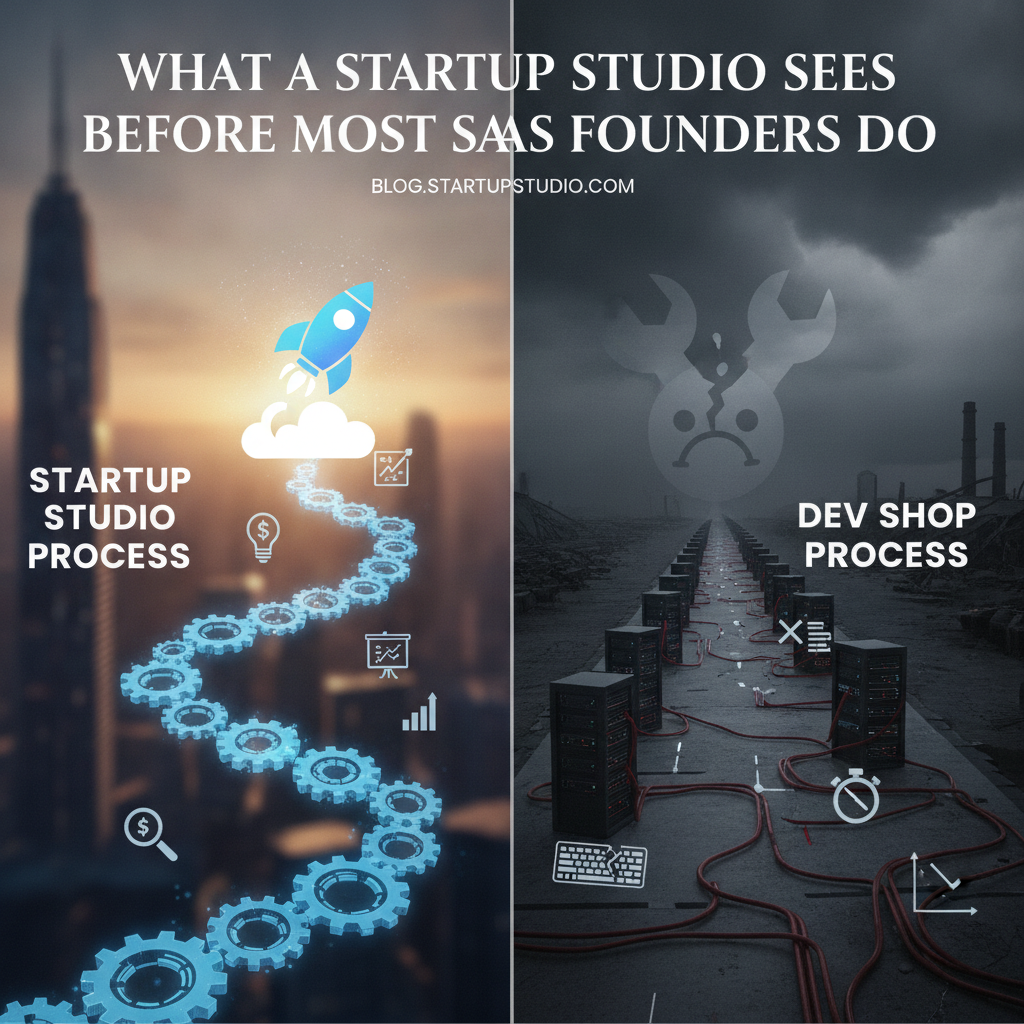
Studios apply a structured production line process to turn ideas into viable businesses. This systematic approach compresses months of trial and error into a predictable timeline.
<b>Step 1:</b> Technical due diligence phase to assess feasibility.
<b>Step 2:</b> Core assumption identification to find the biggest business risks.
<b>Step 3:</b> Ruthless scope prioritization to define the true minimum viable product.
<b>Step 4:</b> Architecture risk assessment for future scalability.
<b>Step 5:</b> Security-first implementation to protect early data.
<b>Step 6:</b> Continuous validation checkpoints with actual users.
A solo founder might spend six months building in isolation. A studio forces knowledge transfer and documentation at every step. They use tested patterns and validated approaches to ensure the final codebase is truly Series A ready.
What Should Founders Look For When Choosing a Startup Studio?
Choosing the right partner is critical for your runway. You need a team that acts as a technical co-founder rather than a passive order-taker.
<b>Key evaluation criteria:</b>
- A portfolio of launched and profitable products.
- Deep technical knowledge in your specific industry.
- Transparent engagement models and pricing.
- Clear post-launch support and handoff structures.
<b>Red flags to watch for:</b>
- Agencies with no actually shipped or surviving products.
- Firms claiming they specialize in absolutely every framework and industry.
- A lack of structured discovery processes.
- Unclear intellectual property ownership terms.
Ask pointed questions during your discovery calls. Request details on their data isolation practices and automated testing standards. Use a cost-benefit analysis framework to decide if a studio makes more sense than hiring an expensive in-house team before you have market validation.
Success Is What You Choose Not to Build
Pattern recognition prevents expensive mistakes. A quality studio provides ruthless scoping discipline, production-grade architecture from day one, and market positioning clarity.
Your success depends entirely on what you choose not to build. Protecting user data through solid architecture is non-negotiable. Targeting specific industry solutions provides a depth over breadth approach that wins in this crowded market. Assess your current project against these signals. The winners of 2026 are the founders who validate fastest, build most securely, and solve industry problems most specifically.
FAQ
How long should a proper SaaS MVP take to build?
Most viable MVPs can be built in six to eight weeks with proper scoping. If your timeline extends beyond twelve weeks, you are likely building features before validating core assumptions. Focus entirely on three to five features that test your riskiest business hypothesis. User onboarding and billing automation can wait until you prove people actually want your core solution.
Why do startup studios prefer Laravel over newer frameworks?
Laravel balances rapid development with production-grade security and scalability. Its mature ecosystem provides battle-tested multi-tenancy, authentication, and authorization directly out of the box. Newer frameworks often require custom security implementation. This adds weeks of development time and introduces vulnerabilities. For products handling sensitive customer data, proven reliability beats trendy technology choices.
What is the real difference between vertical and horizontal SaaS?
Horizontal software serves broad markets, like generic email marketing tools for everyone. Vertical software solves specific industry problems, like an email marketing tool designed exclusively for commercial real estate brokers. Vertical products command higher pricing and face significantly lower churn because they address exact industry workflows, strict compliance needs, and specific terminology.
Can I add AI to my existing SaaS product or do I need to rebuild?
This depends entirely on your existing architecture. Native AI integration requires clean access to your data layer and core workflow logic. If your product uses a modular architecture with clear API boundaries, you can integrate AI features incrementally. If your codebase is tightly coupled and lacks proper data infrastructure, you will face significant and expensive refactoring.
How much does it cost to work with a startup studio versus hiring developers?
Studio engagements typically range from $40,000 to $150,000 for MVP builds and often include equity arrangements. While this seems expensive compared to hiring junior developers, studios compress nine months of trial and error into three months of validated execution. Burning six months on the wrong architecture destroys far more company value than the initial studio premium.